
 Caffeine Break Buddy
Get the magic of your morning cup back
A free caffeine tracker — and an honest guide to what actually happens when you cut back. No shaming your coffee habit, no willpower marathons, and nothing you enter ever leaves your phone.
What caffeine tolerance really is
Adenosine is the molecule that makes you feel sleepy — it builds up across the day and settles onto receptors that dial your alertness down. Caffeine works by blocking those receptors. It doesn't add energy; it hides the tiredness.
With daily use your body adapts. In humans, a week of 250 mg three times a day raised the density of adenosine A2A receptors on blood platelets by about 31%, and made them measurably more sensitive. In rodent brain, chronic caffeine raises A1 receptor binding by roughly 17–20%. More receptors, or more sensitive ones, means the same coffee blocks a smaller share of them — which is tolerance, and it's a physical adaptation rather than a failure of discipline.
Three things most guides get wrong
Nobody has measured caffeine receptor density in a living human brain. Not once. So when a site tells you your receptors reset in exactly 7, 14 or 30 days, that number is invented. The figures above come from human blood cells and from rodent brains. What has actually been measured in people is symptoms — and those resolve in two to nine days.
Tolerance is effect-specific, not all-or-nothing. It's essentially complete for caffeine's effects on blood pressure and adrenaline within one to four days of daily use, and complete for the subjective buzz within about three weeks. But the effect on physical performance is stubborn — cyclists still got a ~4–5% power boost after 15 straight days of daily dosing. "Caffeine does nothing for regular drinkers" overstates a finding that is genuinely still contested.
You don't have to be a heavy drinker. Withdrawal has been produced from as little as 100 mg a day, and after only three days of regular use. In one study of people averaging 235 mg — about two and a half cups — 52% reported moderate or severe headache when it was swapped for placebo.
What the timeline actually looks like
Timings vary with dose and metabolism, but the shape is consistent enough that researchers can put hours on it.
Nothing much. Caffeine's half-life is roughly three to five hours in most adults, so levels are falling but you're not empty yet. Individual values run from about two hours to ten — pregnancy and oestrogen-containing contraceptives lengthen it substantially, smoking shortens it.
Onset. This is when it starts, and if you drink your coffee in the morning that lands squarely on the following afternoon. Headache first for about half of people — typically bilateral and throbbing — then fatigue and the sense of being foggy rather than tired.
The peak — this is the hard part. Headache, real fatigue, low alertness, drowsiness, depressed or irritable mood, difficulty concentrating. Some people also get genuine flu-like symptoms, nausea, or muscle stiffness. About 13% of people in controlled studies hit distress or impairment significant enough to matter at work.
It lifts. The headache is usually the first thing to go. Energy is still flat and concentration still annoying, but the trend is clearly downward.
Done, for almost everyone. The systematic review puts total duration at two to nine days, with the long tail belonging to people who were on high daily doses.
If you go back, you need far less than you used to. Tolerance to the subjective effects is what fades fastest, so your old four-cup habit will hit like six. This is the part people enjoy — and the part they overshoot.
What helps, and what's a waste of money
Actually helps
- Taper rather than stop dead. Standard clinical advice is cutting intake 25–50% every few days. Withdrawal severity tracks the dose you stop from, so a smaller last step means a smaller landing.
- Don't start the day before something that matters. The peak is 20–51 hours out. Friday morning means a wrecked Saturday.
- Expect the headache instead of diagnosing yourself. Half of people get one. Knowing it's on the schedule is most of the battle.
- If you get migraines, talk to someone first. In a small randomised trial of episodic migraine sufferers, abrupt caffeine withdrawal triggered severe attacks in seven of nine people.
- Move the ritual, not just the drug. Most restarts are the 3pm walk to the machine rather than a craving.
- Track the days. A visible number is harder to abandon than a vague intention.
Doesn't work
- "Detox" teas and cleanses. Tolerance is receptor adaptation, not residue. There's nothing to flush.
- Quitting to fix your hydration. Coffee doesn't dehydrate you — in 50 habitual drinkers it hydrated as well as an equal volume of water.
- Bracing for anxiety. Anxiety is an effect of taking caffeine. There's little evidence it's a withdrawal symptom, and the validated list points the other way: drowsiness and fatigue.
- Expecting insomnia. Also not on the validated list, and polysomnography during withdrawal found no change in sleep time, latency, or architecture.
- Assuming it's psychological. A balanced placebo study in 87 coffee drinkers found the pharmacology, not the expectation, drove the symptoms.
- Any promise of a "receptor reset" on a fixed date. That measurement has never been made in a human brain.
What it looks like
Five screens, no clutter. Tap any shot to see it full size.
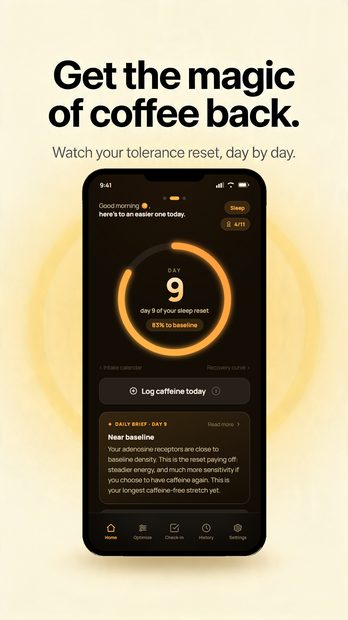
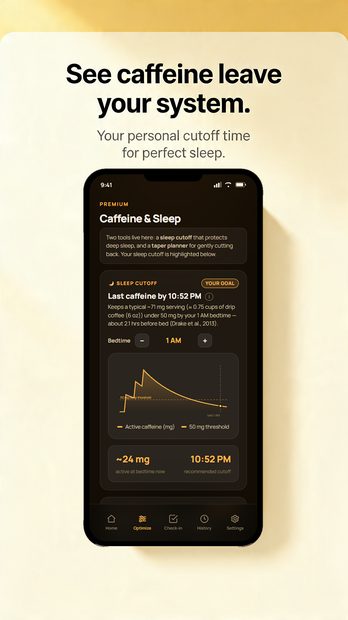
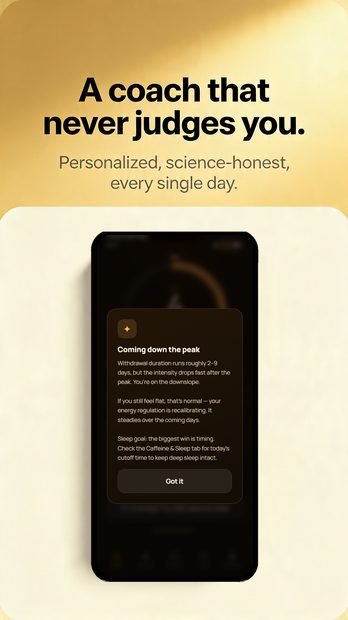


click any screen to enlarge
What Caffeine Break Buddy actually does
It's the timeline above, wired to what you actually drank, with a coach that doesn't lecture.
Inside
- A recovery ring showing your tolerance climbing back toward baseline
- A daily brief that adapts to how you're feeling — and warns you about day two
- Log coffee, espresso, tea, energy drinks, soda, pre-workout, pills or chocolate
- Watch caffeine clear your system between doses
- Money saved and sleep reclaimed, counting up
- Works offline — no connection needed
What it doesn't do
- No account, no sign-up, no email
- Nothing you enter leaves your device
- No subscription — it's free
- No opinion on whether you should be drinking coffee at all
- No streak-shaming if you have a cup anyway
Read the privacy policy — it's short, because there isn't much to disclose.
Caffeine withdrawal FAQ
How long does caffeine withdrawal last?
Two to nine days. The systematic review that settled this looked at 57 experimental and 9 survey studies: symptoms typically start 12 to 24 hours after the last dose, peak between 20 and 51 hours, and run two to nine days in total. Higher daily doses mean longer and rougher.
How much coffee is enough to get withdrawal?
Less than you'd think. Symptoms have been produced by stopping doses as low as 100 mg a day — one small coffee — and three days of daily use is enough for them to appear. In a group averaging 235 mg a day, 52% reported moderate or severe headache when their caffeine was secretly swapped for placebo.
How long until my tolerance resets?
Honestly, nobody knows, and that's the useful answer. Caffeine receptor density has never been measured in a living human brain, so every confident "reset in N days" figure online is made up. What's measured: symptoms clear in two to nine days, and human blood-cell receptor markers return to baseline within roughly 48 hours. Tolerance to the alertness effect is what you actually care about, and most people notice a real difference within a week or two.
Should I taper or quit cold turkey?
Taper, probably. Cutting 25–50% every few days is the standard clinical recommendation, and it's mechanistically sound because withdrawal severity scales with the dose you stop from. But be aware no trial has ever directly compared tapering against stopping abruptly for caffeine, so the size of the advantage is unknown. There's also an odd finding worth knowing: people told exactly when their dose was being cut reported more withdrawal than people who weren't told.
Is caffeine withdrawal a real diagnosis?
Yes — it's in DSM-5 as 292.0 (F15.93) and in ICD-11 as 6C48.3, requiring at least three symptoms within 24 hours plus significant distress or impairment. Caffeine addiction, on the other hand, is not a diagnosis: DSM-5 explicitly declined to include caffeine use disorder and parked it in the section for conditions needing further study.
Will quitting help me sleep?
Timing matters more than quitting. A meta-analysis of 24 studies found caffeine cut total sleep time by about 45 minutes and sleep efficiency by 7% — but the same work found 107 mg needs about nine hours before bed to avoid that, and 217 mg needs about thirteen. Moving your last cup earlier may get you most of the benefit without the withdrawal.
Does coffee dehydrate me?
No. Fifty habitual coffee drinkers went through a controlled crossover comparing four cups a day against the same volume of water: no difference in total body water, 24-hour urine volume, urine concentration, or any blood marker. Coffee hydrated as well as water did.
Is the app free?
Yes. Free, no account required, no subscription, and everything stays on your device.
Sources. Withdrawal onset, peak, duration, headache incidence and the validated symptom list from Juliano & Griffiths, "A critical review of caffeine withdrawal," Psychopharmacology (2004). The 235 mg / 52% headache figure from Silverman et al., New England Journal of Medicine (1992). Dose and duration thresholds from Evans & Griffiths, Journal of Pharmacology and Experimental Therapeutics (1999). Human A2A receptor upregulation from Varani et al., Circulation (1999); rodent A1 figures from Johansson et al. (1993) and Shi et al. (1993). Cardiovascular tolerance from Robertson et al., Journal of Clinical Investigation (1981). Performance tolerance from Lara et al., PLOS ONE (2019). Half-life from Knutti et al. (1981) and Abernethy & Todd (1985). Hydration from Killer et al., PLOS ONE (2014). Sleep architecture from Weibel et al., Scientific Reports (2021); sleep timing meta-analysis from Gardiner et al., Sleep Medicine Reviews (2023). Expectancy from Juliano et al., Human Psychopharmacology (2019) and Mills et al., Journal of Psychopharmacology (2019). Migraine trigger from Alstadhaug et al., Frontiers in Neurology (2020). Tapering guidance per StatPearls, "Caffeine Withdrawal."
This page is general information, not medical advice. If you get migraines, are pregnant, or take medication that interacts with caffeine, changing your intake is a conversation with your clinician.
Same approach, different habit
Caffeine Break Buddy is one of three. THC Break Buddy does tolerance breaks, Nicotine Break Buddy covers cigarettes, vapes and pouches — and all of them keep your data on your own phone. See all the apps.