
 Nicotine Break Buddy
Watch your body heal, day by day
Cigarettes, vapes, pouches, dip — one calm quit app for all of it. An honest timeline of what withdrawal actually does, no shame about slips, and nothing you enter ever leaves your phone.
What nicotine did to your brain, and what undoes it
Nicotine binds nicotinic acetylcholine receptors — chiefly the α4β2 subtype — and leaves them desensitised. Your brain compensates by building more of them. Imaging studies find smokers carry roughly 26–36% more of these receptors in the cortex and about 27% more in the striatum than non-smokers.
That's why the first cigarette of the day lands so hard and why the tenth barely registers. PET work found that one or two puffs occupies half of those receptors for about three hours, and a whole cigarette occupies 88%. Smoking to satiety hits 95%. A daily smoker keeps them saturated essentially all day — so withdrawal isn't an occasional event, it's what happens every time the level drops.
The good news is that this reverses, and it has been measured in living human brains. Receptor levels stay elevated through about a month of abstinence and return to non-smoker levels by six to twelve weeks. An earlier, smaller study put it closer to three weeks. Either way it's a matter of weeks, not years — and it's a real physical repair, not a metaphor.
One honest caveat
Recovery isn't uniform. The occipital cortex was the last region still measurably elevated at four weeks in the best-designed study, and cerebellar levels at that point tracked with how strongly people were still craving. Feeling fine on paper and still getting hit by urges at week five is normal, not a relapse warning.
Not just cigarettes
Most quit apps were built for smoking and bolt everything else on afterwards. This one starts from what you actually use.
What the timeline actually looks like
The research puts real numbers on this, and they're more encouraging than the folklore.
Nicotine's half-life is about two hours. Blood levels peak as you finish and fall fast, and meaningful levels are gone within six to eight hours. Cravings can start about 30 minutes after the last one.
Onset. Irritability, anxiety, restlessness, trouble concentrating, appetite up, sleep disrupted. Worth knowing: DSM-5 requires four of seven symptoms within 24 hours — and craving is not one of them, which surprises most people.
The peak. This is when urges are strongest and mood is worst. If you are going to feel like a different person, it's now.
The window that decides it. Most relapse among people quitting unaided happens inside these eight days. Nothing about this stretch means you're doing it wrong — it means this is the part worth planning support around rather than willpower.
It resolves. Total withdrawal score is back at or near pre-quit levels by about two weeks, and essentially there by three or four. Sleep fragmentation clears in five to fourteen days. Anger and impatience are the stubborn ones.
Receptors reach non-smoker levels. This is the physical finish line, measured by brain imaging rather than inferred.
Urges fade on an exponential curve. At six months about 13% of people still report strong urges; by twelve months essentially nobody does, though around a third still get occasional ones. Occasional is not failure.
What the trials actually support
Backed by evidence
- Pick a quit day and stop outright. In a 697-person randomised trial, abrupt quitting beat cutting down: 49% vs 39% abstinent at four weeks, 22% vs 16% at six months.
- Use nicotine replacement or medication. High-certainty evidence: NRT raises quit rates by about half again; varenicline roughly doubles them.
- If you do cut down first, medicate during the reduction. Reduction with pharmacotherapy clearly beat reduction alone.
- Plan the first eight days specifically. That's where the attempts are lost, so that's where the support belongs.
- Ride out the urge. Health services put a single craving at roughly three to fifteen minutes. It passes whether or not you act on it.
- Treat a slip as data. One study found people with more withdrawal discomfort were no less likely to succeed. A slip is information about a trigger, not a verdict.
Myths worth dropping
- "Tapering is easier and works better." No trial shows that. The biggest head-to-head found abrupt worked measurably better; a 22-study review found them equivalent.
- "Quitting will wreck my mental health." A 26-study meta-analysis found quitters had lower anxiety, depression and stress than continuing smokers — effects comparable to antidepressant treatment, and as large for people with psychiatric diagnoses.
- "Nicotine is what causes the cancer." Four in ten smokers believe this. Nicotine is what makes it addictive; the thousands of other chemicals in the smoke cause nearly all the harm.
- "I'll gain a load of weight." Average gain at a year is about 4.7 kg — but 16% of people lose weight and 37% gain under 5 kg. Neither "no gain" nor "inevitable disaster" is true.
- "Headaches and sweating are withdrawal." Reviewed against the evidence, headaches, sweating, tremor, racing heart and drowsiness are not established abstinence effects.
What it looks like
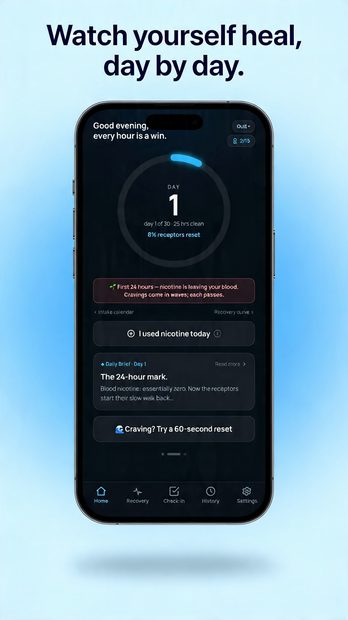
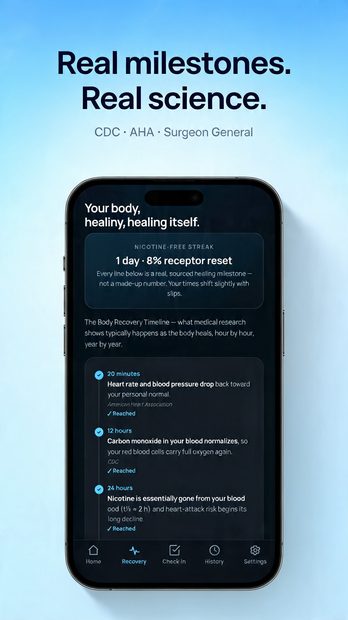
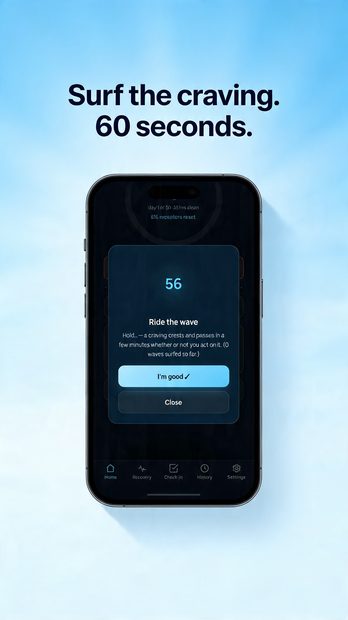
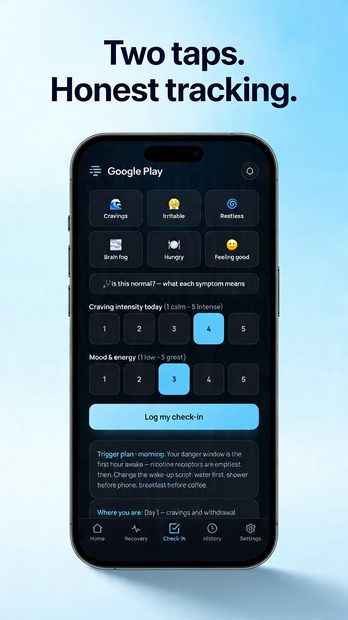
Five screens, no clutter. Tap any shot to see it full size.
click any screen to enlarge
What Nicotine Break Buddy actually does
It takes the timeline above and points it at your own numbers, so quitting stops feeling like deprivation and starts looking like progress.
Free, and genuinely useful
- A receptor-reset ring modelled on the PET imaging above
- Daily briefs that tell you what today's symptoms mean and when they end
- Craving SOS — a 60-second breathing-paced timer to surf the wave and log the win
- Two-tap check-ins for symptoms, craving intensity, mood and energy
- A dependence profile built on the same Fagerström questions clinicians use
- Money saved, nicotine avoided, and ritual time reclaimed, counting up
- 15 milestone badges, streaks, and a Comeback badge for logging a slip
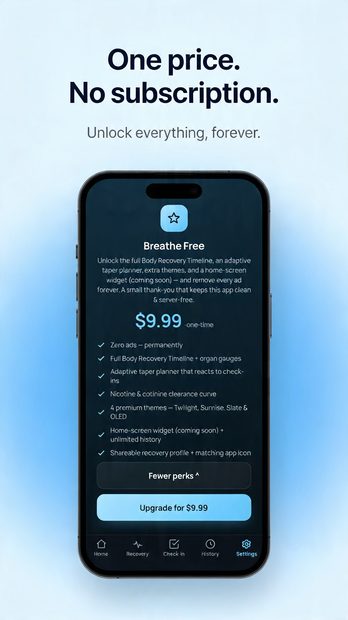
Breathe Free — $9.99, once
- The full body recovery timeline — 12 sourced milestones from twenty minutes to one year
- Organ gauges: heart, lungs, circulation, taste and smell
- An adaptive taper planner that reacts to your check-ins
- Nicotine and cotinine clearance curves, so you can see when tests come back clean
- Four themes, unlimited history, and a shareable recovery profile
- Ads gone, permanently
One payment, not a subscription — the big quit apps in this category charge about that much every year. No account, no sign-up, and nothing you enter leaves your device. Read the privacy policy.
Nicotine withdrawal FAQ
How long does nicotine withdrawal last?
Two to four weeks for most of it. The systematic review of abstinence effects found withdrawal begins in the first one to two days, peaks in the first week, and total scores are back at or near pre-quit levels by two weeks — three to four at the outside. Cravings and increased appetite are the two that can run longer.
How long until my receptors go back to normal?
Six to twelve weeks, and unusually for this kind of claim, it has actually been measured in living human brains. Smokers scanned during abstinence still had elevated nicotinic receptor levels at one month; by six to twelve weeks they matched non-smokers. A smaller earlier study using a different tracer put it at around 21 days.
Should I quit cold turkey or cut down?
The evidence doesn't support cutting down as the easier path. The largest head-to-head randomised trial — 697 smokers, everyone getting nicotine replacement and behavioural support — found abrupt quitting beat a two-week taper at both four weeks (49% vs 39%) and six months (22% vs 16%). A Cochrane review of 22 studies found the two approaches equivalent. So: equivalent at best, worse in the biggest single trial. If you do reduce first, the evidence supports using fast-acting NRT or varenicline during the reduction phase.
Why is the first week so much harder than I expected?
Because that's where the biology is. Urges peak on days two to three, and a review of people quitting without help found most relapse happens within the first eight days. Roughly 3 to 5% of unaided quitters are still abstinent at six to twelve months — which is not a comment on anyone's character, it's an argument for using the tools that work.
How long does a single craving last?
A few minutes. Worth being straight with you: this specific number isn't well established in the research literature, and the official sources disagree — Ireland's HSE says three to five minutes, the NHS says up to fifteen. What is well established is the long arc: urges decline exponentially, about 13% of people still report strong ones at six months, and by twelve months essentially nobody does.
Will quitting make my anxiety or depression worse?
The evidence points the opposite way. A meta-analysis of 26 longitudinal studies found people who quit scored lower on anxiety, depression, stress and mixed anxiety-depression than people who kept smoking, and higher on positive affect and psychological quality of life. The effect sizes were comparable to antidepressant treatment, and just as large for people with psychiatric diagnoses. These are observational studies, so read it as a strong association rather than proof — but "smoking calms my nerves" does not survive contact with the data.
Does vaping help you quit or not?
Both answers are in the literature and the distinction matters. Randomised trials give high-certainty evidence that nicotine vapes beat nicotine replacement therapy for quitting — about four extra quitters per hundred. But real-world data are less kind: daily vaping was associated with more than double the odds of abstinence, while non-daily vaping showed no benefit at all, and both patterns were linked to higher relapse risk among people who'd already made a month. Switching completely and consistently is what the evidence supports. Dabbling is where it turns unfavourable.
Does it work for vapes and pouches, not just cigarettes?
Yes — that's the point of it. You tell the app what you use and roughly how much, and it estimates your daily nicotine load from that rather than converting everything into imaginary cigarettes. Cigarettes, vapes, pouches, dip, cigars and gum are all first-class.
Is it free, and what does the paid unlock get me?
The app is free, and the free tier is a real quit tool — receptor-reset ring, daily briefs, check-ins, craving SOS, money saved, badges and slip logging all work without paying. The optional Breathe Free unlock is $9.99 once and adds the full body recovery timeline with organ gauges, an adaptive taper planner that reacts to your check-ins, the nicotine and cotinine clearance curves, four themes, unlimited history and a shareable recovery profile — and it removes ads for good. There is no subscription, which is the part worth comparing: the major quit apps in this category charge roughly that much every year.
Sources. Receptor upregulation figures from Staley et al., "Human tobacco smokers in early abstinence have higher levels of β2* nicotinic acetylcholine receptors than nonsmokers," Journal of Neuroscience (2006). Normalisation timeline from Cosgrove et al., Archives of General Psychiatry (2009), with the earlier estimate from Mamede et al., Journal of Nuclear Medicine (2007). Receptor occupancy per cigarette from Brody et al., Archives of General Psychiatry (2006). Nicotine pharmacokinetics from Benowitz, Hukkanen & Jacob, Handbook of Experimental Pharmacology (2009). Withdrawal onset, peak, duration and the validity of individual symptoms from Hughes, "Effects of abstinence from tobacco," Nicotine & Tobacco Research (2007). Relapse timing and unaided success rates from Hughes, Keely & Naud, Addiction (2004). Abrupt versus gradual from Lindson-Hawley et al., Annals of Internal Medicine (2016) and Lindson et al., Cochrane Database of Systematic Reviews (2019, CD013183). NRT and varenicline effect sizes from Cochrane reviews CD000146 (2018) and CD006103 (2023); e-cigarette evidence from CD010216 (2025), with real-world data from Cho et al., American Journal of Epidemiology (2026). Mental health outcomes from Taylor et al., BMJ (2014). Weight change from Aubin et al., BMJ (2012). Craving persistence from Ussher et al., Psychopharmacology (2013). Craving-duration figures per NHS Better Health and HSE Ireland. Nicotine-and-cancer misconception figure from Public Health England (2018).
This page is general information, not medical advice. Quitting is much more likely to work with real support — talk to a pharmacist or your doctor about nicotine replacement or medication, and if you're in the US, 1-800-QUIT-NOW is free.
Same approach, different habit
Nicotine Break Buddy is one of three. THC Break Buddy handles tolerance breaks, Caffeine Break Buddy takes on the coffee habit — and all of them keep your data on your own phone. See all the apps.