
 THC Break Buddy
Reset your tolerance, day by day
A free tolerance break tracker, with a plain guide to what happens when you take one. No preaching in either direction, and nothing you enter leaves your phone.
What a tolerance break does
Chronic daily use downregulates your CB1 receptors: your brain reduces the number of available cannabinoid receptors to compensate for a constant supply of THC. Fewer receptors means less effect from the same amount. That is tolerance, and it is a physical change rather than a matter of willpower.
A PET imaging study of chronic daily cannabis smokers found roughly 20% fewer CB1 receptors in cortical brain regions compared with non-users. After about four weeks of monitored abstinence, receptor density returned toward normal, and it did so in the regions that had been depleted to begin with.
Two things most guides get wrong
The famous "21 days" figure is a community convention, not a finding. The imaging study used four weeks. Twenty-one days is directionally reasonable and most people feel a real difference by then, but nobody measured anyone's brain on day 21.
Recovery is gradual. You do not sit at zero and flip to normal on the final day. Most people notice meaningful change well before the finish line.
What each stretch feels like
Timelines vary, but the shape is consistent from one person to the next.
Usually easy, sometimes suspiciously so. Sleep may already be a little off.
The peak, and the hard part. Insomnia; vivid, exhausting dreams as REM sleep rebounds; no appetite; irritability well out of proportion to whatever set you off; anxiety, low mood, restlessness; night sweats, chills, headaches. If you are on day four and feel terrible, that is the schedule rather than a personal failure.
It lifts. Sleep is still imperfect but improving, appetite returns, mood evens out. Most acute symptoms are done inside this window.
This is where it gets pleasant. Dreams settle, sleep gets good (often better than before), and some people report sharper mornings.
Tolerance is meaningfully reset. If you go back, you need far less than you think. People overshoot here all the time and have an unpleasant evening. Start at roughly a quarter of your old amount.
A minority have lingering low mood or sleep trouble. If that is you and it is not lifting, raise it with a clinician rather than an internet timeline.
What helps, and what's a waste of money
What helps
- Plan around days 2–6. Don't start the day before something stressful.
- Exercise, even a walk. The most consistently reported thing that helps in that window.
- Accept that sleep is temporarily broken. Fighting it makes it worse, and it resolves on its own.
- Eat on a schedule even without appetite. Skipping meals makes the irritability worse.
- Track the days. A visible number is harder to abandon than a vague intention.
- Tell one person you know. A friend rather than a forum. It improves the odds you get past day six.
- Move your triggers. Most day-three restarts come down to convenience rather than craving.
Doesn't work
- Detox kits and flush products. Tolerance is a matter of receptor density rather than residue, so there is nothing to flush.
- Sweating it out in a sauna. Same problem. It feels productive and does nothing for tolerance.
- "Just cut back." Works for some people, but if you're reading this you have probably already tested that hypothesis.
- Switching to something else to get through it. That's a substitution rather than a break, and it lands you back here in a couple of months.
- Anything promising a reset in three days. The imaging research used four weeks.
What it looks like
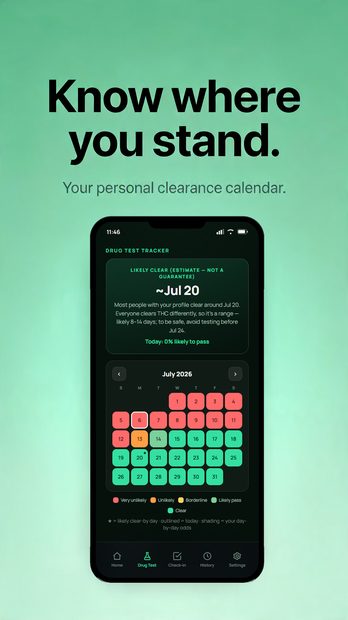
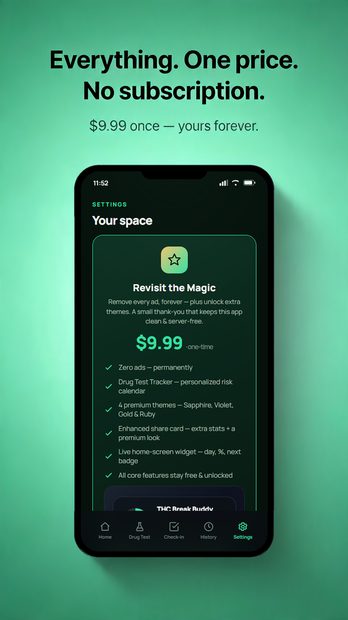
Five screens, no clutter. Tap any shot to see it full size.
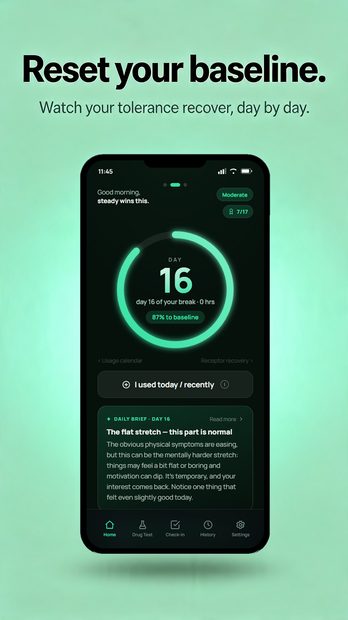
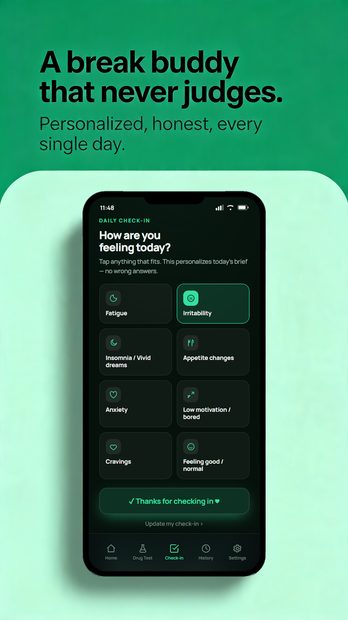
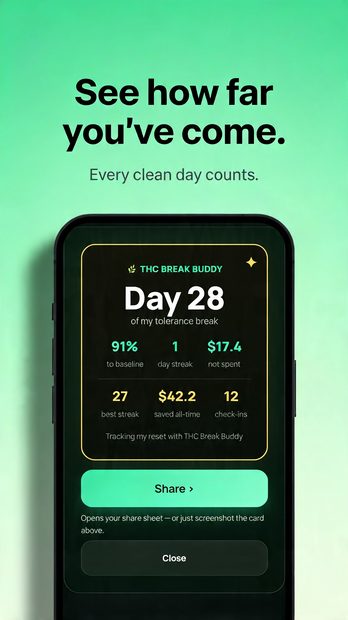
click any screen to enlarge
What THC Break Buddy does
It is a day counter with the timeline above built into it, and it is meant to be no more than that.
Inside
- A running day count, front and centre
- What to expect on the day you're on
- Notes, so you can see which days were hard and why
- Milestones at the points that matter
- Works offline, no connection needed
What it doesn't do
- No account, no sign-up, no email
- Nothing you enter leaves your device
- No streak-shaming if you restart
- No position on whether you should be using at all
- No subscription, ever — the upgrade is a single payment
Read the privacy policy. It's short, because there isn't much to disclose.
Free, and not a trial
- The running day count and everything built around it
- What to expect on the day you're on
- Notes and milestones, kept as long as you want them
- Works offline, with no account and no sign-up
- No time limit, no locked streak, no nagging to upgrade
The free version is the app. The upgrade adds to it rather than switching it back on.
Revisit the Magic: $9.99, once
- The Tracker: a research-based estimate of when you're likely to pass, as a colour-coded calendar built from your usage, body type and test sensitivity
- At-home tests you log sharpen that estimate as you go
- Five more themes — Sapphire, Violet, Gold, Ruby and Frost
- An enhanced share card with extra stats
- Ads gone, permanently
One payment, not a subscription. It is a thank-you that keeps the app clean and server-free. Store pricing varies by region; $9.99 is the US price.
Tolerance break FAQ
How long should a weed tolerance break be?
Most people aim for 21 to 30 days. The imaging study that measured CB1 receptor recovery used four weeks of monitored abstinence. Twenty-one days is a community convention rather than a research finding, but most people report a clear difference by then.
What are the worst days?
Days 2 through 6. Withdrawal symptoms reliably peak in that window: insomnia, vivid dreams, appetite loss, irritability and low mood. Most acute symptoms ease between days 7 and 14.
Why am I having such vivid dreams?
THC suppresses REM sleep. When you stop, your brain catches up on the REM it missed all at once, which produces unusually vivid and sometimes exhausting dreams. It is normal and it settles within one to two weeks.
Do detox drinks lower tolerance?
No. Tolerance is about cannabinoid receptor density, not residue in your system. There is nothing to flush, so detox products don't speed up recovery. That's a separate question from passing a drug test, which is about metabolites.
What if I break early?
Then you have data. Work out which day you restarted and what happened immediately before. Day three at 11pm because you couldn't sleep is a different problem from day twelve at a party, and the two need different plans. Tolerance breaks are a skill, and almost nobody gets the first one right.
Is the app free?
Yes, and the free version is a real tracker: the day count, what to expect on the day you're on, notes, milestones and offline use all work without paying. There is one optional upgrade, Revisit the Magic, at $9.99 once — it adds the pass-likelihood Tracker, five extra themes and an enhanced share card, and removes ads permanently. No account, and no subscription.
Sources. CB1 receptor figures from Hirvonen et al., "Reversible and regionally selective downregulation of brain cannabinoid CB1 receptors in chronic daily cannabis smokers," Molecular Psychiatry (2012). Daily-use figures from SAMHSA's 2025 National Survey on Drug Use and Health. Withdrawal timeline per the DSM-5 cannabis withdrawal criteria and associated clinical literature.
This page is general information, not medical advice. If you use cannabis for a diagnosed condition, changing how you use it is a conversation with your clinician.
There's a community for this
I started r/WeedTBreak for people taking a break: day counts, the rough nights, and no judgment about why you're pausing or whether you go back. If you're stopping for good rather than resetting, r/leaves is the bigger, older community.
Same approach, different habit
THC Break Buddy is one of three. Caffeine Break Buddy does coffee, and Nicotine Break Buddy covers cigarettes, vapes and pouches. All three keep your data on your own phone. See all the apps.
If you're sending it to someone, dlonem.com/thc is one link for both stores. It opens Google Play or the App Store depending on the phone.