
Quitting nicotine
A plan for cigarettes, vapes and pouches: pick the day, choose your support, and get through the weeks that decide it.
What this guide covers
The Nicotine Break Buddy page covers what nicotine does to your brain, the withdrawal timeline, and what the big trials say about quitting in general. This guide is the plan: choosing a day, choosing your support, what is different about vapes and pouches, and the things that catch people out in the first weeks.
Quitting is much more likely to work with real support. Talk to a pharmacist or doctor about medication before your quit day.
Pick a quit day
Smokefree.gov, run by the US National Cancer Institute, says to pick a day in the next two weeks: close enough that you do not lose your nerve, far enough away to get ready. The Institute's older quit booklet sums up the preparation in five steps, which work just as well for vapes and pouches as for cigarettes:
- Set a quit date.
- Tell family, friends and coworkers that you plan to quit.
- Anticipate the challenges you will face, and plan for them.
- Remove every product from your home, car, bag and desk: packs, pods, disposables, pouch tins, lighters.
- Talk to your doctor or pharmacist about help to quit.
Choose your medication before the day
Nicotine replacement works better when you use it well, and the research is specific about what well means:
- Use two forms together. A patch for the steady background dose plus a fast-acting form (gum, lozenge, spray or inhaler) for cravings. Across 16 trials and more than 12,000 people, combining them raised long-term quit rates by about a quarter over using one form alone. The evidence is rated high certainty.
- Consider starting before quit day. Wearing the patch for a while before you stop, known as preloading, raised quit rates by about a quarter across nine trials. That evidence is moderate certainty. Ask a pharmacist how to do it.
- A bigger patch is not better. In the same review, a 42 or 44 mg patch did no better than the standard 21 or 22 mg one.
Prescription options. Varenicline has some of the strongest evidence of any quit medication, and your doctor can say whether it suits you. Cytisine, a plant-derived medicine that works in a similar way, helped more people quit than placebo in the latest Cochrane review, and in the two trials comparing it with varenicline there was no clear difference, though that comparison is low certainty. It is prescription-only in the UK and sold over the counter in Canada and Poland. As of September 2026 it is not approved in the US: in June 2026 the FDA declined to approve it for now, citing manufacturing and labeling issues and not safety or effectiveness, and the company plans to reapply.
One thing that is not a quit aid: nicotine pouches. The FDA has authorized some pouch products to be sold, which is not the same as approval, and none are approved to help people quit.
Line up a person, or a phone
Call a quitline. In the US, 1-800-QUIT-NOW (or 1-855-DÉJELO-YA in Spanish) transfers you to your state's quitline, which is free and confidential. Coaches can help you get medication through your insurance or local programs. Among people who had already called a quitline, extra phone counselling raised the chance of quitting from about 7% to 10%.
Or sign up for texts. Automated text programs raise quit rates compared with minimal support, according to a Cochrane review that rates the evidence as moderate certainty. Three free ones:
- SmokefreeTXT: text QUIT to 47848. It runs for six to eight weeks.
- CDC's texting portal: text QUITNOW to 333888.
- EX Program by Truth Initiative, which now includes the This is Quitting vaping program: text EXPROGRAM to 88709. It is open to anyone 13 or older.
Message and data rates may apply.
Vapes and pouches
Quitting a vape or pouch habit starts with working out how much nicotine you actually take, and that is harder than counting cigarettes.
Vapes. In US sales data, the average nicotine concentration of disposable vapes rose to 48.5 mg/mL by mid-2024, and the average amount of liquid in each device grew from 1.6 mL to 11.7 mL. One disposable can hold far more nicotine than it looks like. The UK caps e-liquid at 20 mg/mL and tanks at 2 mL. Nicotine salts, used in most disposables, let people take high levels without the harshness that would otherwise stop them.
Pouches. US products tested by the CDC ranged from about 1.3 to 6.1 mg of nicotine per pouch. European products tested in another study reached 47.5 mg per pouch. Check the tin, and count pouches per day, not tins per week.
What helps people quit vaping. The evidence is newer but growing:
- In a 2025 trial of 16 to 25-year-olds who vaped but did not smoke, 51% of those given varenicline were abstinent in weeks 9 to 12, against 14% on placebo; both groups also got counselling. By weeks 9 to 24 it was 28% against 7%.
- In trials of the This is Quitting text program, 24% of young adults quit, against 19% of those without it, and among teens 38% against 28%.
- A 2025 Cochrane review concluded that varenicline may help people stop vaping and text-message programs may help young people. For combination nicotine replacement and cytisine, the evidence on vaping is still inconclusive.
Three things that catch people out
Alcohol. Smokefree.gov puts it plainly: for many people alcohol is a trigger that makes them want to smoke, and it makes you more likely to act without thinking it through. A 2023 review found drinking linked to lower quit success in 20 of 27 studies. Stay away from it for the first few weeks if you can.
Coffee, if you smoked. Tobacco smoke speeds up the enzyme that clears caffeine; smokers clear it about 56% faster. When you stop smoking, that effect fades within days: in one study, caffeine clearance fell by about a third, and in another, four days off cigarettes raised the amount of caffeine in the blood over a day by 46%. Levels can stay higher for months. The result is that your usual coffee hits harder, and the jitters and poor sleep that follow are easy to mistake for nicotine withdrawal. New Zealand's medicines regulator suggests halving your caffeine when you quit. This comes from the smoke, not the nicotine. It happens when you stop smoking even if you use nicotine replacement, and it does not apply if what you are quitting is a vape or pouches. The caffeine guide shows how to count and cut back.
Your other medicines, if you smoked. The same enzyme handles several prescription drugs. Doses of clozapine, olanzapine, theophylline and warfarin may need to come down when a smoker quits. If you take any of these, tell your prescriber before your quit day, not after.
Aim for 28 days
The NHS sets the first goal at 28 days without smoking, because people who reach it are five times more likely to quit for good. It turns an open-ended promise into a date on the calendar, and most of the hardest stretch is behind you well before you get there.
If you slip
A slip is not the end of the attempt. Smokefree.gov says it directly: you have not failed and you are not back to square one, and most people need several tries before they stop for good. What you do in the next hour matters more than the slip itself:
- Get rid of the rest. Do not keep the pack, the disposable or the tin "to finish it."
- Go back to the plan straight away, the same day. Not on Monday.
- Work out what set it off: the place, the time, the person, the drink.
- Check your medication. Are you using the patch every day and the fast-acting form when cravings hit, as directed? Under-dosing is a common reason cravings win.
Keep count
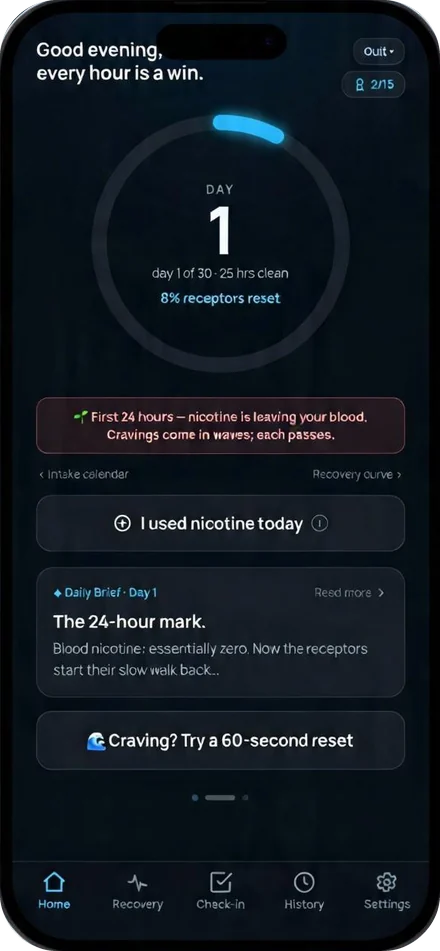
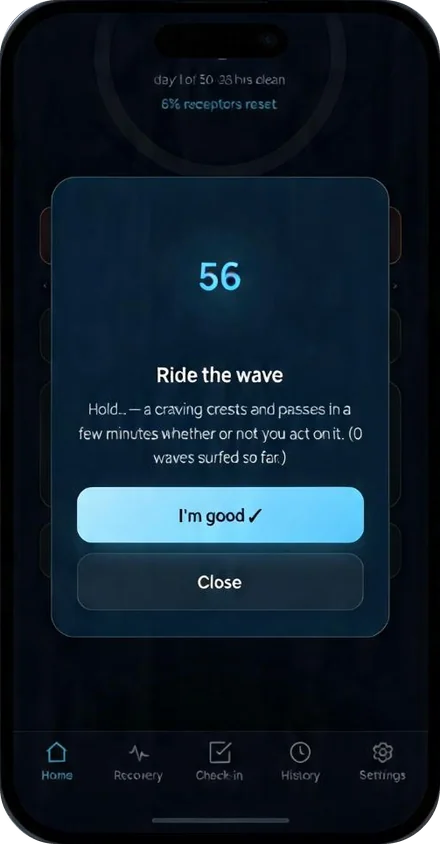
Nicotine Break Buddy is the tracker I built for this. It works for cigarettes, vapes, pouches and dip, and has a 60-second breathing timer for riding out a craving, quick daily check-ins, money saved counting up, and a Comeback badge for logging a slip instead of hiding it. It needs no account, and nothing you enter leaves your phone. It is free on Android: get it here.
Taking a break from something else? There is a guide to cutting back on caffeine and one to cannabis tolerance breaks.
Sources
- Smokefree.gov (National Cancer Institute). Build your quit plan. Link
- National Cancer Institute. Clearing the Air: Quit Smoking Today (START steps). Link
- Theodoulou A et al. Different doses, durations and modes of delivery of nicotine replacement therapy for smoking cessation. Cochrane Database of Systematic Reviews, 2023. Link
- Livingstone-Banks J et al. Nicotine receptor partial agonists for smoking cessation. Cochrane Database of Systematic Reviews, 2023. Link
- NCSCT. Cytisine briefing, 2026. Link
- Achieve Life Sciences. Complete Response Letter from FDA for cytisinicline NDA, June 2026. Link
- CDC. Nicotine pouches. Link
- US FDA. FDA authorizes marketing of 20 ZYN nicotine pouch products, January 2025. Link
- CDC. Quitlines and other cessation support resources. Link
- Matkin W, Ordóñez-Mena JM, Hartmann-Boyce J. Telephone counselling for smoking cessation. Cochrane Database of Systematic Reviews, 2019. Link
- Whittaker R et al. Mobile phone text messaging and app-based interventions for smoking cessation. Cochrane Database of Systematic Reviews, 2019. Link
- Smokefree.gov. SmokefreeTXT. Link
- Truth Initiative. EX Program supports 1 million young people seeking to quit nicotine, May 2026. Link
- Ali FRM et al. Trends in U.S. e-cigarette sales measured in milligrams of nicotine, 2019 to 2024. American Journal of Preventive Medicine, 2025. Link
- GOV.UK. E-cigarettes: regulations for consumer products. Link
- CDC. About e-cigarettes. Link
- Stanfill S et al. Characterization of total and unprotonated (free) nicotine content of nicotine pouch products. Nicotine & Tobacco Research, 2021. Link
- Mallock N et al. Levels of nicotine and tobacco-specific nitrosamines in oral nicotine pouches. Tobacco Control, 2022. Link
- Evins AE et al. Varenicline for youth nicotine vaping cessation: a randomized clinical trial. JAMA, 2025. Link
- Graham AL et al. Effectiveness of a vaping cessation text message program among young adult e-cigarette users. JAMA Internal Medicine, 2021. Link
- Graham AL et al. Text message intervention for vaping cessation among adolescents. JAMA, 2024. Link
- Butler AR et al. Interventions for quitting vaping. Cochrane Database of Systematic Reviews, 2025. Link
- Smokefree.gov. Alcohol and smoking. Link
- van Amsterdam J, van den Brink W. The effect of alcohol use on smoking cessation: a systematic review. Alcohol, 2023. Link
- Kroon LA. Drug interactions with smoking. American Journal of Health-System Pharmacy, 2007.
- Faber MS, Fuhr U. Time response of cytochrome P450 1A2 activity on cessation of heavy smoking. Clinical Pharmacology & Therapeutics, 2004. Link
- Brown CR et al. Changes in rate and pattern of caffeine metabolism after cigarette abstinence. Clinical Pharmacology & Therapeutics, 1988. Link
- Swanson JA, Lee JW, Hopp JW. Caffeine and nicotine: a review of their joint use and possible interactive effects. Addictive Behaviors, 1994.
- Medsafe (New Zealand). Smoking interactions with medicines. Link
- NHS Better Health. Quit smoking. Link
- Smokefree.gov. Tips for slips. Link
- Yorkshire Smokefree (NHS). I've slipped up. Link