
Taking a tolerance break
How long to go, how to get ready, how to get through the nights, and how to come back without undoing it.
What this guide covers
The THC Break Buddy page explains why tolerance happens and what each stretch of a break feels like, day by day. This guide covers everything around a tolerance break, or T-break as most people call it: choosing a length, getting ready, getting through the nights, and what to do on the last day so you are not back here in two months.
If you use cannabis for a diagnosed condition, plan any break with the clinician who knows about it.
How long it needs to be
Two brain-imaging studies have tracked what happens to cannabinoid (CB1) receptors when daily users stop. In the first, heavy users had about 20% fewer receptors than non-users in parts of the brain, and after roughly four weeks of monitored abstinence the gap was gone. The second scanned 11 cannabis-dependent men: their receptors were about 15% lower at the start, the difference was no longer significant after just two days, and it was still gone at day 28. It was a small study of men only, so read it as "recovery starts quickly," not "two days is enough."
What those scans measure is receptors. How strongly you feel the effect afterwards has not been measured the same way, so the length you choose is partly a judgment call. The withdrawal timeline is the other half of it. In the study that mapped it, symptoms usually began on days one to three, peaked between days two and six, and mostly lasted four to fourteen days.
| Length | What you get |
|---|---|
| 2 to 4 days | Receptor recovery has started, but you stop in the middle of the worst stretch. All of the discomfort, little of the payoff. |
| About 2 weeks | For most people the withdrawal is over and the break has stopped being hard. |
| About 4 weeks | The point at which both imaging studies found receptor levels no different from non-users. |
| Longer than a month | Worth it if the goal is to change the pattern and not only the tolerance. See the section on coming back. |
Getting ready
Count forward from your start day. Days two to six are the hard ones, so look at what falls on them. A start day that puts day four on a work deadline or a family visit is a start day worth moving.
Decide what happens to what is left. Finish it before day one, give it away, or put it somewhere that takes real effort to reach. More breaks end because something was within arm's reach at 11pm than because of a craving that could not be managed.
If you mix with tobacco, decide about that now. Spliffs and blunts mean a cannabis break is also a nicotine break unless you keep smoking tobacco on its own. In a small study, stopping both at once was harder than stopping either alone for the first few days, though the difference was short-lived and varied from person to person. In another, cigarette use went up by about 14 a week during a two-week cannabis break, and poor sleep predicted who smoked more. Either plan can work. Know which one you are on before day one, and if you are stopping both, the nicotine guide covers that side.
Set up sleep before you need it. Pick a wake-up time you will keep every day of the break, and set a caffeine cutoff. In a sleep-lab study, 400 mg of caffeine taken six hours before bed still cut total sleep by more than an hour. The caffeine guide has a way to count what you actually drink.
Know what the first week will feel like, and why. Anxiety, irritability, low mood and trouble sleeping are all on the formal list of cannabis withdrawal symptoms. If those are the reasons you use, the first week can feel like proof that you need it. It is withdrawal, and it passes on the schedule above.
Why some breaks are harder
A 2020 review of 47 studies and more than 23,000 people found cannabis withdrawal syndrome in about 47% of regular users. It was more common with daily use and with tobacco use alongside cannabis. A separate review puts it simply: the heavier and longer the use before stopping, the stronger the withdrawal.
Potency matters in a related way. Frequent use of high-potency cannabis has been linked to more severe dependence, while low-potency use was not associated with dependence in the same study. Concentrate users have shown greater physiological dependence even after accounting for other factors. Neither study measured withdrawal directly, so treat it as a reason to plan for a rougher first week, not as a prediction.
Women also tend to report stronger withdrawal, including physical symptoms such as nausea and stomach pain.
If you use daily, use concentrates or mix with tobacco, give yourself the longer runway: a start day with a quiet week after it, and the sleep setup below in place from the first night.
Getting through the nights
Sleep is where most breaks are won or lost. In sleep-lab studies, heavy users slept less and spent less time in deep sleep during their first nights off. In one that recorded people across nearly two weeks of abstinence, total sleep and sleep efficiency went down while time spent awake in the night went up. Strange, vivid dreams are one of the most common complaints, and in one outpatient study sleep trouble and odd dreams were still being reported up to seven weeks in. The research does not agree on the details of what changes, but it agrees that sleep gets worse before it gets better.
The techniques that work for insomnia generally work here too:
- Get up at the same time every day, including after a bad night. It is the single anchor the rest depends on.
- Go to bed when you are sleepy, not at a set time because you think you should.
- If you are still awake after 15 to 20 minutes, get up. Do something calm in low light and go back when you feel sleepy. Lying there trying teaches your brain that bed is where you lie awake.
- Keep the bed for sleep. No scrolling, no shows in bed while this is going on.
- Skip long naps. They take the edge off the sleep pressure you need at night.
Watch the swap. Alcohol helps you fall asleep, then breaks up sleep in the second half of the night and delays dreaming sleep. In one study, people on a two-week cannabis break drank about eight more standard drinks a week. Another found the increase only in people with a past alcohol problem. If that describes you, it is the part of the break to plan for most carefully.
If sleep has not started improving after a few weeks, or you are thinking about sleep medication, that is a conversation for a pharmacist or doctor.
When the break ends
How a break ends matters as much as how long it lasts. A 2023 study followed 170 young adults for six months. Those who took breaks specifically to lower their tolerance were using more hazardously six months later, while those who took longer breaks for other reasons were using less. It was an observational study, so it cannot show the break caused anything. It does match the rest of the research, which consistently ties tolerance to how often you use: regular users feel less from the same amount, and more frequent use goes with a weaker high. Return to the old frequency and you are rebuilding the old tolerance.
So decide the pattern before the last day, and write it down:
- How many days a week, and which ones. This is the number that does the most to keep tolerance down.
- How much, to start. Much less than you used to. Your tolerance is lower than your habits remember.
- What you use. Lower-potency products were not associated with dependence in the research above; high-potency ones were.
One safety point. Tolerance is partial and it differs by effect. In a study of 122 users, the effect of cannabis on thinking and reaction tests was similar whether people used rarely or heavily. Feeling less high is not the same as being less impaired, and it is not a reason to drive.
Signs it is more than a tolerance problem
Tolerance and withdrawal are two of the eleven criteria for cannabis use disorder. The others include using more or for longer than intended, repeated attempts to cut down that do not stick, giving up things you care about, and carrying on despite problems it is causing. A diagnosis is a clinician's call and turns on whether use is causing real problems or distress. If you have tried a break several times and never got past the first week, that is worth taking to one.
Cannabinoid hyperemesis syndrome is worth knowing by name. It shows up in long-term regular users as repeated bouts of severe nausea and vomiting, often with stomach pain. A strong urge to take hot showers or baths, which bring relief, is a telltale sign: in a systematic review, 92% of cases had it. Stopping cannabis is the only treatment that resolves it, and symptoms usually come back if use starts again. If you cannot keep fluids down, get medical care.
In the US, SAMHSA's National Helpline, 1-800-662-HELP (4357), is free, confidential and open 24 hours a day, every day of the year, in English and Spanish. It is a referral and information service that can point you to treatment near you. Outside the US, your doctor or local health service is the place to start.
Keep count
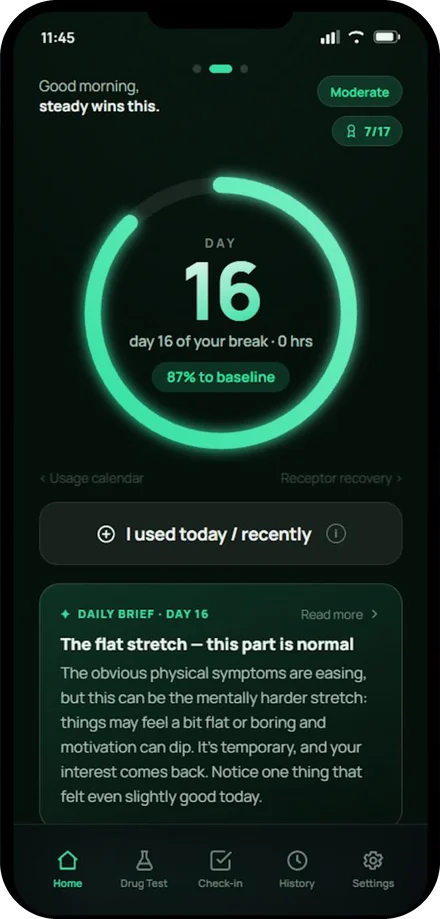
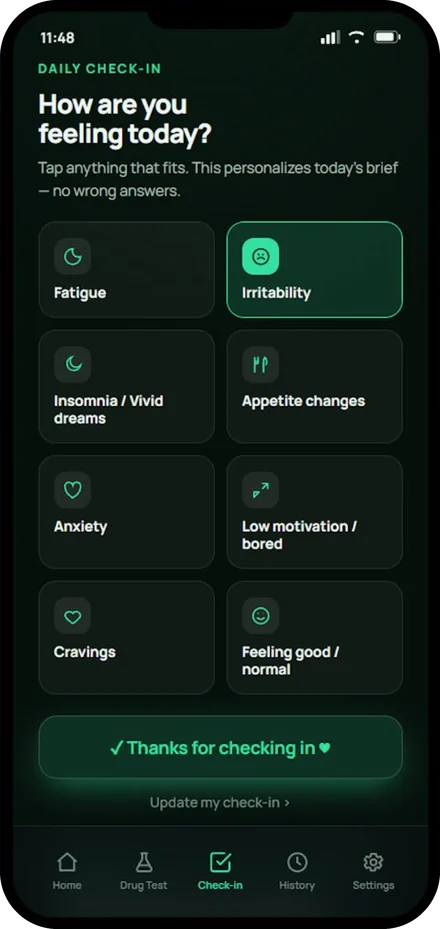
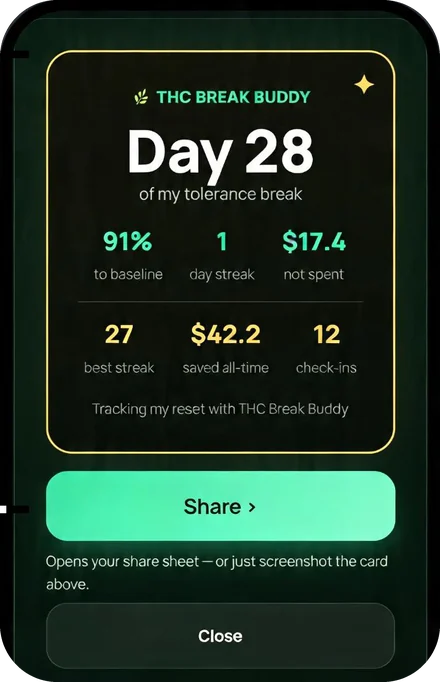
THC Break Buddy is the tracker I built for this. It is a day count with the timeline built in, somewhere to note which days were hard and why, and milestones at the points that matter. It needs no account, and nothing you enter leaves your phone. It is free on Android and iPhone: get it here, and the link picks the right store for your phone.
Taking a break from something else? There is a guide to cutting back on caffeine and one to quitting nicotine.
Sources
- Hirvonen J et al. Reversible and regionally selective downregulation of brain cannabinoid CB1 receptors in chronic daily cannabis smokers. Molecular Psychiatry, 2012.
- D'Souza DC et al. Rapid changes in CB1 receptor availability in cannabis dependent males after abstinence from cannabis. Biological Psychiatry: CNNI, 2016. Link
- Budney AJ et al. The time course and significance of cannabis withdrawal. Journal of Abnormal Psychology, 2003. Link
- Bonnet U, Preuss UW. The cannabis withdrawal syndrome: current insights. Substance Abuse and Rehabilitation, 2017. Link
- Bahji A et al. Prevalence of cannabis withdrawal symptoms among people with regular or dependent use of cannabinoids. JAMA Network Open, 2020. Link
- Freeman TP, Winstock AR. Examining the profile of high-potency cannabis and its association with severity of cannabis dependence. Psychological Medicine, 2015. Link
- Meier MH. Associations between butane hash oil use and cannabis-related problems. Drug and Alcohol Dependence, 2017. Link
- Vandrey RG et al. A within-subject comparison of withdrawal symptoms during abstinence from cannabis, tobacco, and both substances. Drug and Alcohol Dependence, 2008. Link
- Allsop DJ et al. Changes in cigarette and alcohol use during cannabis abstinence. Drug and Alcohol Dependence, 2014. Link
- Peters EN, Hughes JR. Daily marijuana users with past alcohol problems increase alcohol consumption during marijuana abstinence. Drug and Alcohol Dependence, 2010. Link
- Drake C et al. Caffeine effects on sleep taken 0, 3, or 6 hours before going to bed. Journal of Clinical Sleep Medicine, 2013. Link
- Bolla KI et al. Sleep disturbance in heavy marijuana users. Sleep, 2008. Link
- Bolla KI et al. Polysomnogram changes in marijuana users who report sleep disturbances during prior abstinence. Sleep Medicine, 2010. Link
- Vandrey R et al. Sleep disturbance and the effects of extended-release zolpidem during cannabis withdrawal. Drug and Alcohol Dependence, 2011. Link
- Gates P, Albertella L, Copeland J. Cannabis withdrawal and sleep: a systematic review of human studies. Substance Abuse, 2016.
- Schutte-Rodin S et al. Clinical guideline for the evaluation and management of chronic insomnia in adults. American Academy of Sleep Medicine, 2008. Link
- NHS inform. Sleep problems and insomnia self-help guide. Link
- Ebrahim IO et al. Alcohol and sleep I: effects on normal sleep. Alcoholism: Clinical and Experimental Research, 2013. Link
- Ansell EB et al. Cannabis use breaks in young adults: the highs and lows of tolerance breaks. Drug and Alcohol Dependence, 2023. Link
- Colizzi M, Bhattacharyya S. Cannabis use and the development of tolerance: a systematic review of human evidence. Neuroscience & Biobehavioral Reviews, 2018. Link
- Freeman AM et al. A dose-response relationship between frequency of cannabis use and tolerance. Journal of Psychopharmacology, 2021. Link
- Ramaekers JG et al. Cannabis and tolerance: acute drug impairment as a function of cannabis use history. Scientific Reports, 2016. Link
- Nimmana BK et al. Cannabis Use Disorder. StatPearls, NCBI Bookshelf. Link
- Sorensen CJ et al. Cannabinoid hyperemesis syndrome: diagnosis, pathophysiology, and treatment. Journal of Medical Toxicology, 2017. Link
- Cleveland Clinic. Cannabis hyperemesis syndrome. Link
- SAMHSA. National Helpline. Link